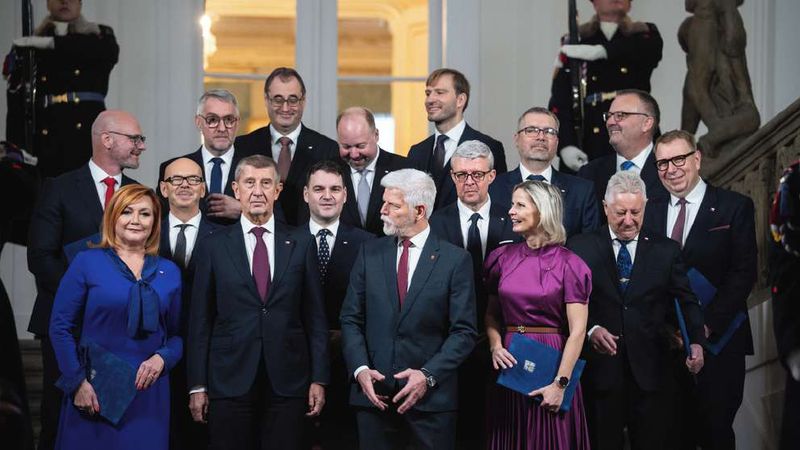
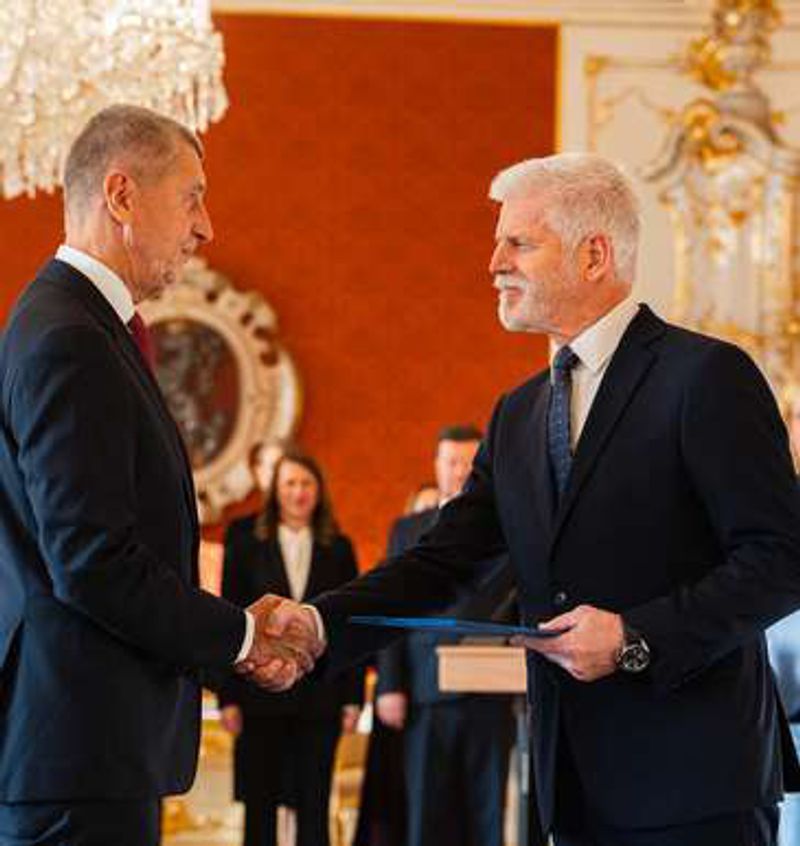
On 15 December 2025, Czech President Petr Pavel swore in 15 ministers of Andrej Babiš’s (ANO) third cabinet, formally launching a new government. In the months since, the cabinet has been shaped by who took which ministry, how power is divided inside the coalition, early foreign policy moves and a number of controversies.
The coalition is led by center-left ANO 2011 movement, currently the largest political party with 80 seats in the Czech Chamber of Deputies.
The coalition is led by center-left ANO 2011 movement, currently the largest political party with 80 seats in the Czech Chamber of Deputies.
Alongside ANO, the government is joined by two smaller parties -far-right Freedom and Direct Democracy party (SPD), and Eurosceptic, anti-environmentalist Motorists for Themselves (AUTO) party. Both of their parliamentary groups are smaller, as SPD has 15 MPs, and Motorists just 13.
Inside the new government, we can find a total of 15 ministries, as well as the position of Prime Minister, which is occupied by a well-known political figure, Andrej Babiš (ANO). His party has taken a total of nine portfolios, including Babiš’s own, the most out of all coalition parties. These portfolios include the Ministries of Finance, Trade and Industry, Labour and Social Affairs and several others. ANO also has two out of four Deputy Prime Ministers, namely Karel Havlíček (ANO) and Alena Schillerová (ANO).
Even though they are the smallest coalition party, Motorists for Themselves have been appointed with four ministries, one more than SPD. Petr Macinka (AUTO) is now not only the Minister of Foreign Affairs, but also the acting Minister of Environment. This is due to the ongoing scandal of Filip Turek (Indep.), who was rejected as minister by President Pavel over a lack of respect for the law, following several of his scandals. Other portfolios for the Motorists are the Ministry of Culture, and the Ministry for Sport, Prevention and Health.
SPD has decided not to nominate their own politicians for the ministries, but rather ‘experts’ in the respective fields. The right-wing party received three portfolios – the Ministries of Defense, Transportation and Agriculture. The party’s leader, Tomio Okamura (SPD), opted to become the President of the Chamber of Deputies, likely due to the various benefits this position offers.
For Andrej Babiš, some ministers are surely more important than others, since they not only lead the most crucial ministries, but they also serve as coalition guarantees or political agenda enforcers. The most important of them all is Karel Havlíček (ANO), First Deputy PM, Minister of Trade and Industry, and so-called ‘second man of ANO’. Havlíček is an important mediator between Babiš and other coalition partners. If one day, Andrej Babiš decides to leave politics, we will likely see this man take over the ANO movement.
Another important figure of the new government is the already mentioned Minister of Finance, Alena Schillerová (ANO). Being in charge of the budget, she is tasked with funding ANO’s election pledges, some of which are quite economically irresponsible. Schillerová is also important in communication with the party’s MPs, since she was the chair of ANO’s parliamentary group during the previous electoral term. Being Babiš’s close ally, as well as the most important woman of the party, gives her significant power.
The cabinet also consists of ministers, who are more ‘moderate’ than others. These include Minister of Education Robert Plaga (ANO) or Minister of Health Adam Vojtěch (ANO). Both these ministers served in the same position during Babiš’s first and second cabinets. Plaga has repeatedly criticized his coalition partner SPD for their statements towards the Ukrainian minority in Czechia. Vojtěch is also well known, as he ruled the health sector during the COVID-19 pandemic in 2020, often being criticized for chaos.
Important ministers in the new Czech government are not only from the ANO movement. The second largest coalition party, SPD, has appointed Jaromír Zůna (Indep.), a retired army general, as Minister of Defense and Deputy PM. Just a few days after being sworn in, Zůna surprisingly stated that ‘Support of Ukraine will continue. We stand on Kyiv’s side; it’s just defending itself. Russia is the aggressor’.
These words resonated both positively and negatively. MPs from opposition parties such as ODS or STAN supported Zůna, thanking him for the continuing support of Ukraine. However, SPD, a party known for its critical stance towards Ukraine, and at the same time the party that appointed him to be minister, started criticizing him for his words. This led to his ‘silencing’, as the government agreed that from now on, Zůna should only speak about defense matters, not foreign policy.
Another controversial persona of Babiš’s cabinet is Martin Šebestyán (Indep.). Even though the Minister of Agriculture was nominated by SPD, he has close ties to Babiš and his conglomerate, Agrofert. Šebestyán used to be a lobbyist of the group, in which the agriculture business accounts for approx. 40% of sales. Thus, there are concerns that Šebestyán might take steps in favor of Agrofert, completely turning around the strategy of the previous agriculture minister, Marek Výborný (KDU-ČSL).
Motorists for Themselves have been the center of attention for quite some time, mainly due to the previously mentioned scandals of Filip Turek. In September, investigative journalist Zdislava Pokorná released an article about Turek’s deleted social media posts. In these posts, he has been accused of openly adhering to the Nazi regime, stating that ‘burning a gypsy child is a mitigating circumstance’, or expressed other sexist, homophobic and racist tendencies. This scandal adds to the already large amount of disturbing information about him, including his shady business with toxic medicine or rape allegations.
From the moment the scandal with social media posts was revealed, President Petr Pavel, PM Andrej Babiš and Motorists’ chairman Petr Macinka had several meetings regarding Turek’s nomination for minister. Previously, Turek was supposed to take the Ministry of Foreign Affairs, but in hope of success, he and Macinka swapped their portfolios. The President did eventually name Macinka the Minister of Foreign Affairs, but since Pavel insisted on keeping Turek out of government, the Motorists’ chairman was also named the acting Minister of Environment, till the party finds a different candidate.
In early January, Petr Pavel sent out a letter to PM Babiš, in which he stated that Turek ‘repeatedly demonstrated a lack of respect for the fundamental value of the rule of law: the willingness to comply with the legal order of our state.’ A few days after this statement, Turek was named Government Commissioner for Green Deal and Climate Policy. This means he can officially attend the government council meetings but cannot directly decide on any matter regarding the agenda of the Ministry of Environment.
A close ally of Turek’s, who has constantly supported him through all his scandals, is Boris Šťastný (AUTO), the Minister of Sport, Prevention and Health. He is the only minister of the cabinet without a portfolio, which means he has no specific responsibility as head of a government department. However, his role inside the government is important, being the main negotiator of Motorists due to his relations with the PM.
‘Support of Ukraine will continue. We stand on Kyiv’s side; it’s just defending itself. Russia is the aggressor’.
During its first months, the government made several controversial decisions. Babiš has also shifted the Czech foreign policy more towards the ideals of Donald Trump, mainly when it comes to the support of Ukraine.
Since the government has received support from the Chamber of Deputies, whose members approved the cabinet with 108 votes in favor, it is now clear that the cabinet can continue in the steps it has started to take. Will Babiš face serious problems in the coming years, or will his third cabinet be successful and beneficial for Czechia?