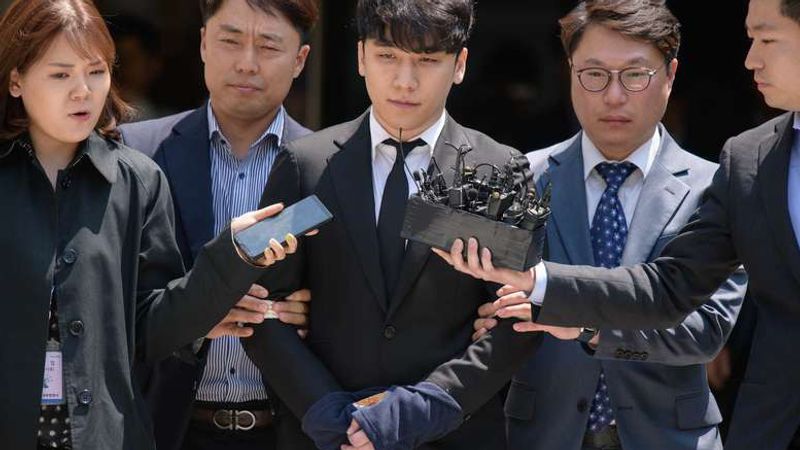
The scandal did not begin with a puff of marijuana smoke. It began with hidden cameras and group chats in a Gangnam nightclub that exposed a predator’s playground. In those logs, some of South Korea’s most famous male idols joked about drugging women, plotted rapes, and swapped secret sex tapes as if they were trading cards. Female high-school students were allegedly forced to perform for wealthy clients and told to “act sexy” while older men laughed. The police who were supposed to protect them were instead accused of taking bribes to look the other way. Seven chart-topping stars were arrested on charges ranging from drug possession to group sexual assault. Tens of thousands of women marched outside the presidential Blue House, chanting “rape cartel” and demanding justice in a system stacked against them. Burning Sun was not just a nightclub; it was a crime scene that revealed how fame, money and misogyny could combine to create a machine of exploitation.
Yet in the midst of this horror, the loudest public outrage was directed at a different member of the same boy band—T.O.P, who admitted to smoking marijuana, fainted from an overdose of prescribed sedatives and disappeared from public life. He would spend years in exile for a non-violent drug offence that harmed no one. The scandal that truly mattered laid bare a hidden world of sexual violence; the one that stuck destroyed a career for a drug that is decriminalised in many countries. This contradiction reveals a deeper truth about K-pop fame: image violations are treated as unforgivable, while crimes that brutalise women can be minimised, excused or forgotten.
BIGBANG were not just another boy band; they were one of the groups that built modern K-pop. Formed by YG Entertainment in 2006, the quintet— G-Dragon, T.O.P (Choi Seung-hyun), Taeyang, Daesung and Seungri— rewrote the idol rulebook by composing their own songs and blending hip-hop swagger with pop hooks. Hits like “Lies,” “Haru Haru” and the stadium-rock anthem “Fantastic Baby” dominated Korean charts and earned them legions of fans worldwide. By 2012 they were headlining arenas in the United States and Europe, showing that Korean music could compete on a global scale They became one of the country’s best-selling boy bands and were credited with pioneering K-pop’s global boom.
Even during mandatory military service, the members pursued solo projects; T.O.P released the art-rap single “Doom Dada” in 2013, while G-Dragon topped charts with avant-garde tracks. Taeyang married and started a family and Daesung opened a YouTube channel. The group’s 2022 comeback song “Still Life,” recorded after a four-year hiatus, shot to No. 1 across Asia with introspective lyrics.
For many fans BIGBANG represented a rebellious, authentic alternative to manufactured pop – a testament to what could be achieved when idols seized creative control.
That mythology made their fall all the more shocking: one member would drag their name into a scandal built on the exploitation of women, while another would become the symbol of a drug panic.
Then they met reality in early 2019. CCTV footage broadcast by MBC News showed security staff at the Gangnam nightclub called Burning Sun dragging a man into a back room and beating him.
The man, Kim Sang-kyo, said he had intervened to stop a woman from being drugged and molested. Instead of investigating his complaint, police detained Kim, fuelling rumours that the club—run by Yuri Holdings, a company jointly owned by Seungri and businessman Yoo In-seok—enjoyed protection from powerful allies. Journalists soon obtained KakaoTalk messages in which Seungri and other club executives allegedly arranged prostitutes for foreign investors and bragged about paying off police. Group chats linked to singer Jung Joon-young showed male stars sharing explicit videos of women without consent and joking about rape. In one chat, Jung wrote, “Let’s all get together online, hit the strip bar and rape them in the car,” to which another man replied, “Our lives are like a movie. We have done so many things that could put us in jail”.
“Let’s all get together online, hit the strip bar and rape them in the car,”
The scandal widened to include allegations of drugging women, sex trafficking, tax evasion and bribery. Financial journalist Ha Hyun-Ock described it as part of a “triangular mafia” linking celebrities, businessmen and public authorities.
Amid the deluge of revelations were allegations that the club and its associates targeted very young girls. Writer Joo Won Kyu, who spent months interviewing runaways for his book on Gangnam nightlife, told reporters he had seen a girl in sixth grade – about 12 years old – being sold at a club. He said teenage girls were plied with GHB or other drugs and forced to sell sex. While these claims were not tested in court, they underscored a fear that the Burning Sun network was exploiting minors. Other victims were in their late teens and early twenties.
According to a Washington Post commentary, many women who appeared in the illegally filmed videos were in their early twenties and did not know they were being recorded. Vox reported that eight women paid about $4,800 each were flown to the Philippines to entertain Seungri’s investors at his 2017 birthday party and that a woman later testified she believed she had been assaulted by five men after seeing chat-room messages. The picture that emerged was not of consensual adult partying but of a system where women were commodities.
Public reaction was visceral. Thousands of women rallied outside the presidential Blue House holding signs that read “rape cartel,” demanding systemic reform. The protests drew on a broader feminist movement that had already been campaigning against hidden-camera abuse and lenient sentences for sexual crimes. Activists linked Burning Sun to earlier tragedies, such as the 2009 death of actress Jang Ja-yeon, who left letters naming men who had allegedly forced her into sexual acts. They argued that South Korean society rarely takes sexual violence seriously and that the male-dominated justice system was more focused on protecting the elite than safeguarding victims. The scandal only gained traction after a male victim – Kim Sang-kyo – spoke up; women’s testimonies alone might not have sufficed.
For many, Burning Sun was proof that the justice system and media are biased in favour of men. The protests forced President Moon Jae-in to order investigations into police collusion and cover-ups across multiple club districts. At the centre of the Burning Sun saga was Seungri, the youngest member of BIGBANG and the public face of Yuri Holdings. Prosecutors alleged that he arranged sex workers for Japanese and Taiwanese investors in 2015 and misappropriated club funds. He was also accused of gambling in Las Vegas and violating foreign-exchange laws, with gambling debts totalling about 2.2 billion won. A military court initially sentenced him to three years in prison in August 2021, but a higher court reduced the term to 18 months after he admitted guilt and paid restitution; the Supreme Court finalised the sentence in May 2022, and Seungri was released from Yeoju Prison in February 2023. He was convicted on nine counts, including arranging sex trafficking, embezzlement, habitual gambling, and foreign-exchange violations.
However, Seungri was not alone. Singer Jung Joon-young and former FT Island musician Choi Jong-hoon were convicted of gang raping an unconscious woman and distributing sex videos; Jung received six years and Choi five, sentences later reduced on appeal. Other chat-room participants, including members of the bands Highlight and CNBLUE, admitted to viewing illegal footage and left their groups. Despite the grave nature of the crimes—secret recordings, group rape and human trafficking—many sentences were shortened. The legal response appeared dissonant with the harm inflicted.
If Burning Sun tarnished BIGBANG’s legacy, Seungri’s post-prison activities have deepened the unease. In October 2025, Cambodian news reported that Prince Brewing, a club-pub operated by Prince Enterprises (also known as Prince Holdings), was closed, and preparing to reopen under new ownership. The closure might have gone unnoticed except for the fact that Seungri had visited the establishment.
In this context, Seungri’s appearance at a Prince Brewing event raised eyebrows. ChosunBiz noted that the Prince Group is suspected of being behind organized human trafficking and illegal confinement, with its chairman under U.S. and U.K. sanctions. It also noted that no direct relationship between Seungri and Prince Holdings has been established. Except for a translated article from OSEN amplified speculation.
Reporter Oh Hyuk-jin claimed that Seungri “parties with high-ranking members of Cambodian criminal complexes” and “aimed to create a second Burning Sun in Cambodia”. He alleged that Seungri associates with “money launderers, voice phishing criminals and mostly people involved in the casino industry”.
The sensational headlines contrast with more cautious reporting. While Seungri’s comments about Cambodia were real and Prince Brewing’s closure drew attention, there is currently no confirmed evidence that he is building a new Burning Sun or that he is directly involved with Prince Group’s criminal operations. Still, in this context, Seungri’s association—even tangentially—with companies linked to Prince Group illustrates how far he has strayed from his idol beginnings. It also raises the question of whether his search for new revenue streams abroad reflects the enduring stigma he faces at home.
While investigators were unravelling the Burning Sun network, another BIGBANG member had already become a pariah for a very different reason. In June 2017 the Seoul Central District Court found T.O.P guilty of smoking cannabis. He admitted to consuming the drug (illegal in South Korea) with a trainee singer in October 2016 four times with a trainee singer. The judge warned that drug offences could “have negative effects on society as a whole,” but acknowledged that T.O.P had no prior convictions and expressed remorse. The court therefore sentenced him to 10 months in prison, suspended for two years, and fined him 12,000 won. In other words, he would only serve time if he offended again.
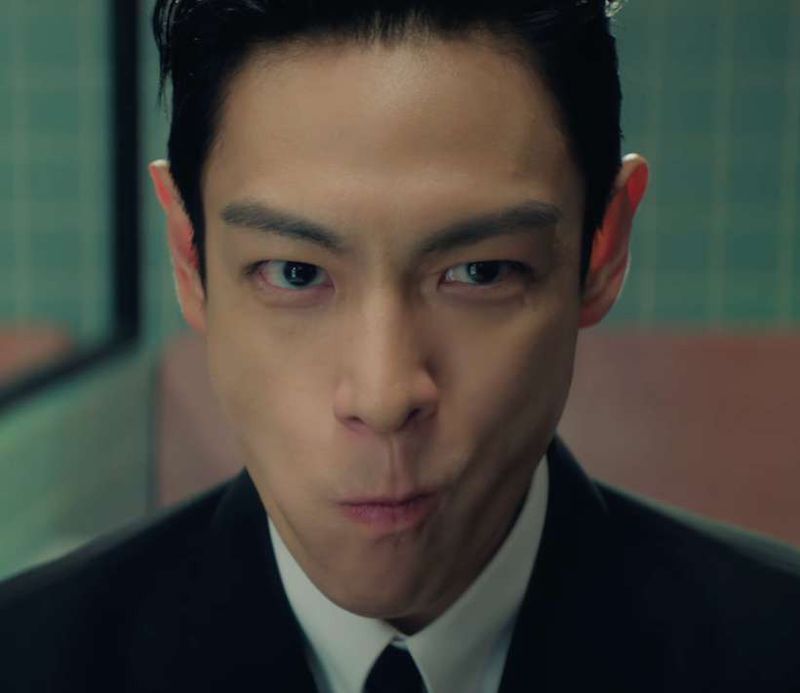
Despite this lenient legal outcome, the public reaction was unforgiving. T.O.P was immediately removed from his military police band; KBS banned him from broadcasts; and he became a target of tabloid shaming. Days after his indictment, he was found unconscious in his police barracks after overdosing on prescribed anxiety medication. He was taken to intensive care, regained consciousness, and later apologised to fans in a handwritten letter, saying he felt “deep embarrassment” and deserved any punishment.
The scandal effectively ended his career. For nearly a decade, he lived almost entirely out of the public eye, focusing on music and recovery. In interviews, T.O.P said he spent the time grappling with guilt, anxiety and the pressure of perfection expected of idols. Although he was not imprisoned, he described feeling as though he had been “completely cut off from the public” and emphasised that his exile was self-imposed to avoid burdening BIGBANG. Unlike his bandmate, he was not accused of harming anyone; his crime was using a drug that many countries have decriminalised. Yet the social consequences were harsher and longer-lasting than those faced by men convicted of sex crimes.
T.O.P’s unlikely return began in 2024 when Netflix announced that he had been cast in Squid Game Season 2. He played Thanos, an eccentric rapper who is described as a “loose cannon”— a man-child under the influence of powerful drugs, with wild mood swings and no regard for consequences. To prepare, T.O.P researched how addicts behave and worked with director Hwang to create a character whose English was clumsy and whose raps were intentionally cringeworthy. Crucially, he saw the role as an opportunity to confront his own past. “When I encountered this character, I had to come face to face with my own mistakes,” he told Awards Focus. “By making fun of them through Thanos, I was able to reflect and move forward”. The performance required him to turn personal shame into dark comedy, turning Thanos not into a villain but into a pathetic figure whose chaotic energy disguised deeper pain. It resonated: fans who had been silent since 2017 flooded social media with memes praising his scenes.
He channelled that goodwill into art. On April 3, 2026, T.O.P released his first full-length solo album, Another Dimension. He revealed that he had been crafting the album for nearly a decade and described it as an attempt to organise his past self and cross into a new chapter. BIGBANG members G-Dragon and Taeyang publicly liked posts about the album, signalling support despite his departure from the group. T.O.P explained that he chose not to rejoin BIGBANG partly out of pride and partly to avoid weighing down the others; he wanted his redemption to stand apart from the band that had made him famous.
The juxtaposition between Seungri and T.O.P exposes a profound moral dissonance in K-pop. One man orchestrated prostitution and profited from a business that facilitated sexual crimes; yet eventually returned quietly to his private life after serving a few years.
The other – whose offence harmed no one – was effectively exiled. Even after his return, some Koreans continue to view him as a cautionary tale about deviance.
Drug use is a serious offence under Korean law, but to many outside observers it pales in comparison with violence against women. Marijuana is decriminalised or legalised in parts of North America and Europe. Even countries with strict drug laws rarely treat cannabis as more socially toxic than sexual assault. In South Korea, however, drug use is associated with moral corruption.
We should question why the entertainment industry and public morality ration outrage in ways that seem disconnected from harm. If K-pop’s image is built on spotless idol personas, perhaps anything that threatens that myth becomes unforgivable, regardless of whether anyone was hurt. Meanwhile, crimes that contradict the industry’s sexist underbelly are easier to downplay. By treating drug use as a character flaw and sexual violence as an unfortunate misstep, Korean society reveals what it truly fears: not harm but the tarnishing of a carefully managed brand.
Korean society reveals what it truly fears: not harm but the tarnishing of a carefully managed brand.
BIGBANG’s story is not just about one band’s downfall; it reveals the fault lines of Korean celebrity culture. The group helped export Korean music to the world, but its legacy now includes burning scandals and moral contradictions. But their story is not over. G-Dragon, Taeyang and Daesung continue to perform; they headlined Coachella in April 2026 and plan a world tour to mark their 20th anniversary. T.O.P has redefined himself with Another Dimension.
Seungri, for now, remains outside the music industry but continues to make headlines for his business dealings and remarks.
What can be learned from the Burning Sun scandal and its aftermath? First, that celebrity culture often turns legal cases into morality tales, imposing punishments that have little to do with the law. Second, that South Korea’s justice system still struggles to treat sexual violence with seriousness. Sentences for gang rape and illicit filming were reduced on appeal, and the men involved will likely live comfortable lives. Third, that public shame is distributed selectively. T.O.P’s case underscores how a non-violent drug offence can carry a harsher social penalty than crimes involving real victims.
This is not unique to Korea – Western media also often fixates on drug use while overlooking abuse – but the Burning Sun scandal brings the contradiction into stark relief. The result is a moral double bind. It is easy to enjoy the music and performances BIGBANG and its contemporaries continue to deliver; it is harder to confront the structures that allowed exploitation to flourish. Holding both truths at once – the joy of the art and the anger at the harm – may be the only way to honour the victims and push for change.
If there is any positive lesson in this mess, it is the power of public outcry. Women’s protests pushed the government to investigate Burning Sun and spurred conversations about consent, misogyny and corruption. Global attention on Prince Group’s crimes led to cross-border raids, indictments and billions of dollars in seizures. Artists like T.O.P have used their second chance to speak about their mistakes and the dangers of drug abuse. But real change will require the industry to care as much about protecting people as it does about protecting images. Until then, the moral equation that ignited Burning Sun will continue to haunt K-pop—a fallen empire still grappling with what it values most.
In the end, perhaps the most tragic thing about BIGBANG is that their legacy now exists in fragments. There is the legendary group that changed K-pop forever, the artists who made imperfection feel charismatic, and the voices that soundtracked an entire generation. T.O.P’s absence sits at the centre of that fracture. A quiet farewell feels fitting for a group whose ending was never clean. Still, for many fans, his loss remains one of the most painful parts of BIGBANG’s unraveling. We will miss him not because the past can be restored, but because his presence was part of what made BIGBANG feel complete. What remains now is not the myth of untouchable idols, but a cautionary story about what happens when an industry protects image more fiercely than people.