
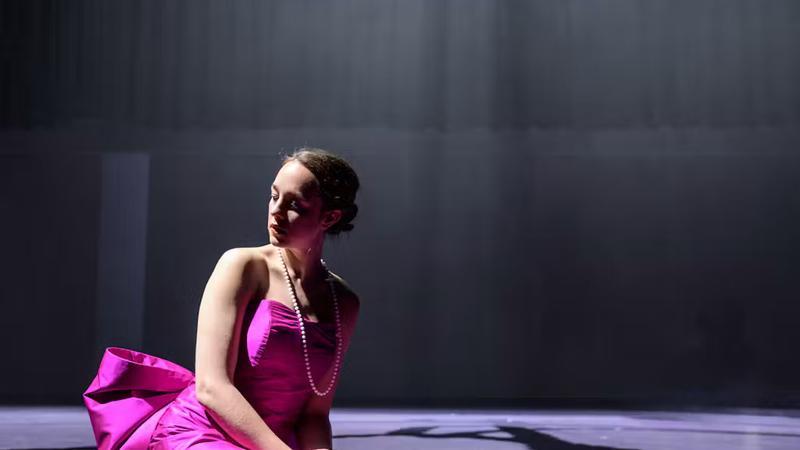
So white, so soft, yet with a bite of arsenic? It’s at the tip of her fingers. There’s always more, in her dreams, in the lives of other people. This is Ema
Bovary: dreamer, lover, prisoner of her own appetite and the protagonist of the modernized play Madame Bovary adapted from the eponymous book by Gustav Flaubert. This adaptation of the famous novel about the power of romantic imagination was directed by Tomáš Loudný and has been in the repertoire of Stavovské Divadlo since 2024.
Ema, so young, so bright, as pure as her white veil stretching out behind her. Who wouldn’t fall in love with Denisa Barešová’s Madame Bovary? Not Radúz Mácha’s Monsieur Karel Bovary, her devoted husband. Without her, he would be just “Karbovary”, a doctor with no purpose, no love, and no wealth. But a few steps behind, the mother listens to the young lovebirds: Martina Preissová as Mrs. Bovary senior, tolerated for what she provides, not for what she has to say. Ema will be a proper wife; she won’t even stumble upon the lives other husbands have to offer. Halls of fame, pomegranates, battles, danger, scarves with monograms, power, control and most important of all - maraschino ice cream. After the couple’s wedding, days come and pass, and nights are quiet in the towns of Tostes and Yonville. Madame Bovary’s dreams are more distant than ever; the stories in her books are just a fantasy, forever stuck in her mind. But what would happen if she tasted just a little bit, just a pinch of soft, white sugar? Don’t think about it too much; the show is starting.
When you first walk into the theater hall, on the steps leading to the stage, a little off-center sits a heel. Not just any heel, one generous in size, like a piece of furniture. The symbols used in production as props and scenery have a striking, loud effect on the viewer. The shiny shoe or the pearl necklace takes many forms – from an ordinary object to a characteristic element of the entire scene. Their obvious presence on the otherwise empty stage contrasts with the unclear and almost hidden meaning. Do they represent Ema’s ambition, her obsession with class and wealth or her fascination with the lives of others? The indications are glaring at us, mocking our confusion. Yet even the mirrors at the sides are highlighting them, and we are forced to focus on their reflection.
The visual references complement the characters and the story, overflowing even into the costume design. If you watched Harry Potter and the Order of the Phoenix (2007), you might remember the famously deliberate design of Doroles Umbridge’s attire. A similar idea is implemented on our main character in the play – Ema.
While Umbridge’s clothes changed because she started to reveal her true nature, Ema’s character development is a little more intricate. Her light and modest pink dress and white veil slowly but surely change into a more fashionable and brightly colored silhouette with an accessory that is either a decoration, restriction or a torturous instrument. The development of her wardrobe not only changes with her perception of real life, but also her attachments, her desire, and eventually the path to her downfall.
Madame Bovary is being portrayed as a tragical story, tackling serious issues of fantasy vs. reality, the limited role of women, marriage, adultery and materialistic values. However, the piece does not get by without some comedic relief. Whether it’s noted on the cost of energy, managing personal finances or the constant surveillance of stepmothers, the audience can find comedy in the everyday life of the Bovary family. The maid Victorie, brought to life by Tereza Jarčevská, with her whimsical dance creations, Petr Vančura as the pharmacist Homais running around among cardboard cutouts of chickens, and the ruthless businessman Monsieur Lhereaux, portrayed by Pavel Neškudla as he plays his sly little tune of deceit, support the fast pacing and lighthearted moments that punctuate the story’s darker turns.
The public opinion about this play remains inconsistent. Some critique the underrepresentation of Madame Bovary’s historical context and the simplification of Flaubert’s complex characters. Others praise the provided space for individual perspective and the accessibility of the story to people who aren’t familiar with the book. Considering that the book itself is often described as a timeless work, providing insights into the lives of humanity no matter the time or space, there is a capacity for a deviation from the original narrative. Although, it is important to acknowledge the history of the book’s origin and development throughout time, to realize its importance and to be able to integrate it into the values of today’s society. From my perspective, the play provided many initiatives to engage the audience and help the viewer understand the elaborate nature of the characters and their situations, without hesitating to implement a striking vision of what the story can be outside of a written text. While the portrayal of inner streams of thoughts in a play will always be different from a book, there is more room for personal observations and a more immediate, individual approach to the work’s essence. In doing so, the play transforms literary reflections into vivid, lived moments full of bliss, passion and intoxication.
Comments